
Barcode readability in cold storage
Add optical margin for frost and curvature. A desk scan is not a freezer scan.
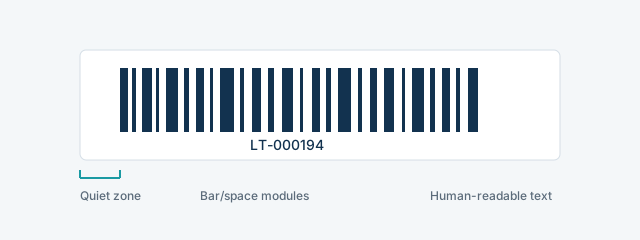
Barcode quality documents such as ISO/IEC 15416 assume a clean symbol on a flat, well-lit surface. A vial in a −80 °C rack violates all three assumptions. The wrap is curved. Lighting is poor. Ice crystals sit on the modules. Designing for cold storage means adding margin that a desk verifier will not demand.
Make the code bigger than you think
If space allows, increase module size and quiet zones beyond the printer’s minimum. Frost eats edges. A symbol that grades well at 20 °C can fail when the effective contrast drops. Two-dimensional codes help on small vials because they pack data, but they still need intact finder patterns. ISO/IEC 18004 QR symbols are not exempt from ice.
Contrast choices
Black resin on a matte white film is easier than grey-on-silver. Metallic and clear materials photograph well and scan badly under frost. If a vendor sample is glossy, try it in the actual cabinet lighting.
Scanner environment
Warm imagers in cold rooms fog. Operators learn to “scan harder,” which is not a control. Keep spare windows clean, allow optics to acclimate if needed, and do not rely on a single lucky angle. GS1 symbol rules still apply to quiet zones even when the operator is wearing mittens.
Human-readable insurance
Print the ID large enough to read at arm’s length. When the imager fails, the archive should not depend on tribal knowledge. Clinical identification culture (unique IDs, no guessing) is still relevant in research freezers: mixed vials are unusable vials.
Related: barcode label basics and condensation.
Quiet zones in real wraps
A verifier card has generous margins. A vial wrap does not. Place the symbol away from the overlap and away from the cap skirt, then add a millimetre you think you cannot afford. That millimetre is often the difference between a grade that passes in the print room and a no-read in the aisle.
If you use both linear and 2D symbols, do not nest them so a scan window sees two symbologies at once. Operators in gloves will not aim with desktop precision. Separate the codes or print only one per facing.
Print darkness that looks bold to the eye can still fail a verifier if bars have ragged edges from a worn head. Cold storage then adds frost on top of those ragged edges. Keep print-process control at room temperature and environmental margin in the freezer as two separate checks. Passing only one of them is how laboratories argue about “bad labels” for months.
Questions this page answers
Should I verify barcodes with a grader at room temperature only?
Do that for print process control, then also attempt reads in the storage environment. You need both.
Are 2D codes immune to frost?
No. They tolerate some damage better than linear codes, but contrast and finder patterns still matter.
Can I laser-etch instead of labeling?
Some tubes support direct marks. That is a different process with its own contrast and debris issues. It is not automatically better.
Why do codes on box ends scan better than vial wraps?
They are flatter and larger. Use that advantage for boxes, and still identify vials individually.
Sources you can check
- ISO/IEC 15416, linear barcode print quality
- ISO/IEC 18004, QR Code
- GS1 barcode standards
- ISBER Best Practices for Repositories
External sites are cited for verification. Labeltaglab is not affiliated with those organizations. See the external links disclosure.