
Microscope slide labels
The frosted end is the only safe neighborhood for identification. The rest of the glass belongs to the specimen.
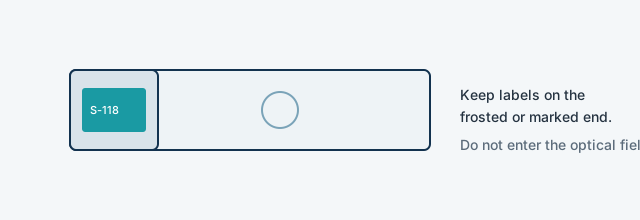
A standard microscope slide is a flat glass rectangle with a small reserved end for writing. That end may be frosted, painted, or colored. The rest of the glass is an optical surface. A label that creeps into the specimen area is not a labeling success; it is a microscopy defect.
Size and thickness
Slide labels are small, often on the order of the frosted zone only. Thick laminates can jam cassettes, stainers, or coverslipper magazines. Thin paper can tear in solvent racks. You are balancing durability against mechanical clearance. If you use an automated stainer, check the manufacturer’s limit for added thickness rather than assuming a desktop printer label will pass.
Stains and solvents
Hematoxylin–eosin processing, special stains, and coverslipping expose slides to alcohols, xylene or substitutes, and sometimes heat. The image must not dissolve while the adhesive still holds—or the reverse. Chemical resistance here is a timed solvent path, not a splash on a bottle. See chemical-resistant labels and solvent exposure and print durability.
Printers used in histology
Some laboratories print on the slide itself with dedicated slide printers; others apply polymer labels. Laser-printed paper labels are common for teaching collections that never see xylene. Clinical and research histology usually need a film and ribbon combination that the solvent path has actually met. Thermal-transfer resin images are often discussed for this reason, without any single brand being required.
Two-dimensional codes on slides
A 2D symbol can encode an accession number in a few millimetres, which is why it fits the frosted end better than a long linear barcode. Print quality still matters: damaged finder patterns and low contrast fail in the same way ISO/IEC 18004 QR symbols fail anywhere else. Leave a quiet margin inside the frosted area so stage clips do not chew the code.
Human factors
Pathologists and technicians still read slides by hand. Pair the code with a short accession string. Color-tinted ends can help sorting but should not be the only identifier. If slides are archived for years, fade and adhesive yellowing become part of the records problem, not only a bench inconvenience.
Cassettes, slides, and two different solvent lives
Tissue cassettes and finished slides do not share a solvent schedule. A cassette may see processing reagents for hours; a slide may see a shorter stain program and then years of archive in the dark. Do not assume a cassette printer ribbon is the slide-label ribbon. If both exist in the laboratory, document both.
Pencil on frosted glass is a traditional backup. It can survive some solvents that destroy cheap paper stickers, and it can still smudge. If pencil is part of the SOP, say so, and still print a unique accession when the workflow is clinical or high-volume. Teaching collections can be more tolerant; clinical archives usually cannot.
Archive lighting and adhesive aging
Slide drawers are not ovens, but adhesives still age. Yellowing, edge dust, and brittle films appear after years. If slides must remain identifiable for a stated retention period, include aged examples—or at least a longer bench solvent test—rather than a same-day wipe. Labeltaglab does not assign retention periods; your records policy does.
Questions this page answers
Can I write on the label with a marker after printing?
Only if the topcoat accepts the marker and the later solvent path does not lift that ink. Many printed films reject pencil and some pens.
Why did labels fall off in the stainer but not in a solvent jar test?
Spray, heat, agitation, and rack design differ from a still jar. Test the instrument program you use.
Do coverslipper temperatures count as autoclave conditions?
No. They are a milder heat, but they can still affect certain adhesives and thermal prints. Treat them as their own step.
Should the label wrap onto the back of the slide?
Usually no. Wrap can lift in solvent and can interfere with focus or stage movement. Stay on the frosted face unless the instrument maker says otherwise.
Sources you can check
- ISO/IEC 18004, QR Code
- ISO/IEC 15416, linear barcode print quality
- OSHA Hazard Communication Standard
- Clinical and Laboratory Standards Institute
- College of American Pathologists
External sites are cited for verification. Labeltaglab is not affiliated with those organizations. See the external links disclosure.