
Laboratory label basics
A laboratory label is a stack of materials doing three jobs: identify, adhere, and remain readable.
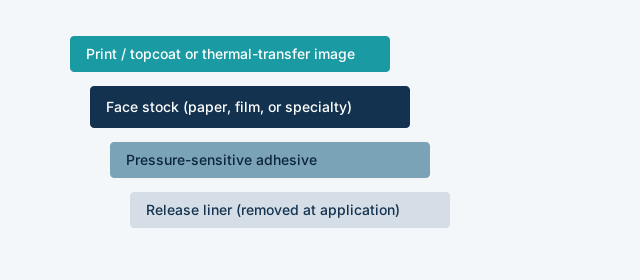
A laboratory label is a small information system. It has to carry an identifier, stay attached to a specific surface, and remain legible after storage, transport, cleaning, or sterilization. Those three jobs fail for different reasons, which is why “a sticky paper rectangle” is not a specification.
The four parts of a typical label
Most laboratory labels are pressure-sensitive. You peel a liner and press the adhesive onto the container. The visible sheet is the face stock. The image may be toner, inkjet ink, a thermally printed dye, or a thermal-transfer ribbon melted onto the surface. Some constructions add a topcoat or a laminate.
Face stock can be paper or a polymer film such as polyester or polypropylene. Paper is easy to write on and inexpensive, but it drinks liquids and tears when wet. Films generally resist moisture better and can take tighter curves, but they still depend on the adhesive and the print method.
Adhesives are not all the same chemistry. Acrylic, rubber, and specialty cold-temperature formulations behave differently on plastics, glass, and slightly oily surfaces. A label that grips a dry polypropylene tube at 20 °C may lift after a freeze–thaw cycle. Peel tests such as those in the ASTM D3330 family measure adhesive performance under defined conditions; they do not replace an application trial on your actual tubes.
What the label must communicate
Human-readable text, linear barcodes, two-dimensional symbols, and RFID chips can share one label or live on separate marks. Clinical laboratories often treat unique identifiers as a patient-safety control. The Joint Commission’s National Patient Safety Goals emphasize reliable identification, and professional bodies such as the College of American Pathologists and CLSI publish laboratory practice documents that assume specimens remain traceable. This site does not interpret those programs for a specific lab; it only notes that identification quality is part of quality systems, not a decorative extra.
Write the minimum data that still distinguishes the item: a unique ID, and whatever your SOP requires (date, study code, hazard mark). Overfilling a tiny cryovial flag with dense text makes both people and scanners fail. Pair a scannable code with a short human-readable string so a frosted tube can still be checked by eye.
Application is part of the product
Adhesive needs contact. Frost, condensation, powder, leftover release coating, or residual alcohol can prevent wet-out. Apply to a clean, dry surface when the procedure allows it. Wrap labels so edges land on the label itself or on a smooth area, not on cap threads or heavy mold seams. Finger pressure along the full length matters more than a quick tap in the center.
If containers are labeled before filling, consider whether later wiping, ice-bucket water, or autoclave steam will hit the same edge. If they are labeled after filling, consider whether the wall is already cold or wet. Those two workflows need different materials, which is why temperature and failure modes deserve their own pages.
Write-on versus preprinted versus on-demand
Marker-only identification is still common for short-lived bench work. Solvent-based markers can survive better than water-based pens, but they smear on some films and disappear in others. Preprinted sequential labels reduce handwriting error but freeze the data at print time. On-demand thermal printers let a LIMS encode the ID at the moment of use. Each method has a matching print technology.
| Layer | Typical job | Common failure if mismatched |
|---|---|---|
| Image / topcoat | Carry text and codes | Fade, smear, low barcode contrast |
| Face stock | Dimensional stability and writeability | Tear, shrink, cockle, poor wrap |
| Adhesive | Stay on the substrate through the process | Edge lift, fall-off, residue |
| Liner | Protect adhesive until use | Difficult peel, contaminated adhesive |
Standards talk about identification, not a single “lab label”
There is no one ISO number that certifies a generic laboratory sticker. Barcode print quality is described in ISO/IEC 15416 for linear symbols. Two-dimensional symbols have related ISO/IEC methods. GS1 maintains widely used data structures for barcodes. Biobanking quality systems such as ISO 20387 and ISBER Best Practices discuss traceability and storage discipline. Sterilization is described in families such as ISO 17665 for moist heat. Hazard communication follows rules such as OSHA’s Hazard Communication Standard when chemical hazards are in scope. Use those documents as context, not as a substitute for a label data sheet.
Third-party manufacturers publish application guides. LabTAG is one such manufacturer; treat vendor literature as manufacturer information, not as Labeltaglab’s own testing. See also choosing label materials.
Questions this page answers
Is a freezer label the same as a cryogenic label?
Not necessarily. Many freezer labels are intended for about −20 °C to −80 °C ranges described by their manufacturers. Liquid nitrogen (−196 °C) and vapor-phase storage add thermal shock and tighter surfaces. See the cryogenic and freezer guides.
Can I use ordinary office labels in a laboratory?
Office labels can work for dry, ambient paperwork. They are a poor default for solvents, steam, or ultra-low storage because paper, adhesive, and toner were not selected for those stresses.
Do I need both a barcode and printed text?
A scannable code speeds inventory. Human-readable text is the fallback when frost, orientation, or a missing scanner blocks the code. Many labs keep both on the same label.
Where should I start if labels keep falling off?
Identify whether the surface was wet or cold, whether the wrap was too short, and whether chemicals contacted the edge. The problems page walks through those checks.
Sources you can check
- ASTM D3330/D3330M, peel adhesion of pressure-sensitive tape
- ISO/IEC 15416, linear barcode print quality
- GS1 barcode standards
- College of American Pathologists
- Clinical and Laboratory Standards Institute
- The Joint Commission, National Patient Safety Goals
- ISO 20387, Biotechnology — Biobanking
- ISBER Best Practices for Repositories
External sites are cited for verification. Labeltaglab is not affiliated with those organizations. See the external links disclosure.