
Label material comparison
Compare face stock, adhesive, and image as separate layers. A strong film cannot rescue a weak print.
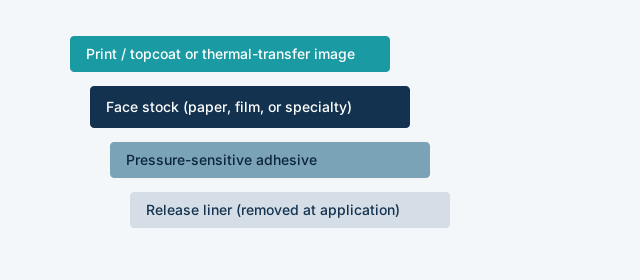
Material comparison is a layer comparison. Face stock, adhesive, topcoat, and print method can be mixed in many constructions. Two labels that both look like “white plastic” can differ in film chemistry, adhesive family, and ribbon receptivity. This page is a map, not a ranking of manufacturers. LabTAG and other specialist vendors publish their own matrices; read those as vendor matrices.
Paper face stocks
Paper accepts pencil, some markers, and many office printers. It absorbs water, tears when wet, and cockles in steam. Use it for dry, ambient documents and for teaching collections that never see solvents. It is a weak default for freezers with frost and for histology.
Polypropylene and polyethylene films
Polyolefin films are flexible and often wrap small tubes well. Flexibility helps on curves; it can also mean more stretch and more chance of barcode distortion. Chemical resistance varies with the specific film and print.
Polyester films
Polyester (PET) is typically stiffer and more dimensionally stable, which helps barcode geometry and heat. Stiffness can fight very small diameters unless the label is small or a more flexible adhesive compensates. PET is a common partner for resin ribbons.
Adhesive families
Acrylic adhesives are widely used for permanence and aging. Rubber-based adhesives can grab quickly on some surfaces but may have different chemical and temperature limits. Cold-temperature adhesives are formulated to wet at lower temperatures; they are not automatically LN2-capable. Peel tests such as ASTM D3330 compare adhesives on defined panels. Your tube is a different substrate.
Topcoats and laminates
A topcoat can make a film accept ribbon or toner. A laminate can add abrasion and solvent protection but also thickness and edge path for liquid. On slides, extra thickness is a mechanical risk. On vials, a laminate edge can still be the peel start.
| Layer | Often chosen when… | Watch for… |
|---|---|---|
| Paper | Dry, writable, low cost | Water, steam, tear |
| Polyolefin film | Tight wraps, flexibility | Stretch, variable solvent behavior |
| Polyester film | Dimensional stability, heat | Stiffness on tiny vials |
| Acrylic adhesive | General permanence | Cold wet-out if not formulated for cold |
| Resin thermal-transfer image | Chemicals and abrasion | Ribbon/film mismatch |
For a decision sequence, see choosing label materials. For failures, see common labeling problems.
Liners, unwind, and printer path
The liner is not just scrap. A stiff liner may refuse a small-diameter mandrel. A weak liner may tear in a thermal printer and leave adhesive on the platen. If operators peel by hand, a liner that rips into fibers contaminates the adhesive. Specify liner behavior for the way you actually dispense—desktop printer, manual fanfold, or sheet.
Removable adhesives exist for temporary bench marks. They are the wrong family for a ten-year archive. “Permanent” adhesives still fail on frost and solvent. Use the words as starting filters, then test. Colored face stocks can help sorting and can also reduce barcode contrast; if you tint the film, verify the code on that tint, not on a white sample.
Do not compare catalogs by adjective
Words such as “cryo,” “ultra,” or “solvent-proof” are not standardized across manufacturers. Two SKUs with the same adjective can differ in film, adhesive, and ribbon. Compare constructions layer by layer, and keep the vendor’s data sheet with your trial notes. Mention of a manufacturer such as LabTAG on this site is a reminder that data sheets live with vendors, not here.
Questions this page answers
Is polyester always better than paper?
For wet, solvent, or steam jobs it is usually the more conservative face stock. For a dry notebook label, paper can be appropriate.
Can I compare two labels by thickness alone?
No. Thickness does not tell you adhesive chemistry or print method.
Do ‘permanent’ adhesives never come off?
Permanent is a marketing and test-condition word. Heat, solvent, and poor wet-out still remove labels.
Should I use a laminate on every tube?
Only if the extra edge and thickness are acceptable and a trial shows a benefit. Laminate is not a universal upgrade.
Sources you can check
- ASTM D3330/D3330M, peel adhesion of pressure-sensitive tape
- UL 969, marking and labeling systems
- ISO/IEC 15416, linear barcode print quality
- ISO 17665:2024, moist heat sterilization
External sites are cited for verification. Labeltaglab is not affiliated with those organizations. See the external links disclosure.