
Planning a fair label trial
Copy the real process in miniature. A trial is a notebook record, not a certificate or a service.
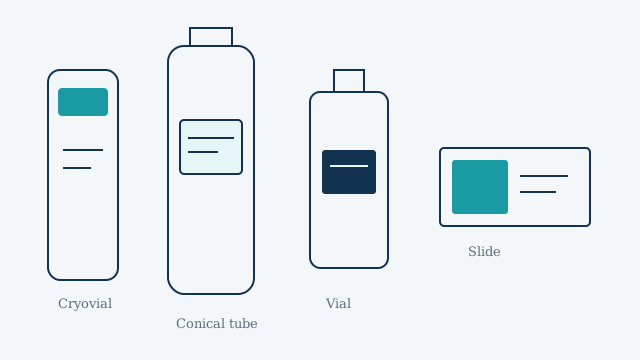
Laboratories need a way to compare label constructions without pretending to be an accreditation body. A fair trial is a written miniature of the real process: the real container, the real print settings, the real chemical, the real freezer, the real operator gloves. It produces a notebook record, not a logo.
Write the intended use in one paragraph
Example: “Identify 2.0 mL polypropylene cryovials applied at ambient temperature, stored in vapor-phase nitrogen, thawed weekly, wiped once with 70% isopropanol, scanned with handheld imager X.” If you cannot write that paragraph, you are not ready to request samples from anyone, including specialist manufacturers such as LabTAG.
Control the print
Lock darkness, speed, ribbon, and printer model. Print the same barcode content. If you change two variables at once, you will not know which one mattered. ISO/IEC 15416-style grading, even with a simple verifier, helps for the print half.
Define pass and fail before you start
Examples: no edge lift beyond 1 mm after 10 freeze–thaw cycles; barcode still reads in the rack; no smear after five alcohol wipes. If you decide the pass line after seeing the results, you are storytelling. ISBER and ISO 20387 expect controlled processes; your trial can be modest and still be controlled.
What this trial is not
It is not ISO certification, not a medical device validation, not a CAP inspection, and not a Labeltaglab service. This site does not receive samples or issue reports. Keep records inside your institution.
Sample size honesty
Three tubes tell you more than zero. They do not tell you a failure rate of 0.01%. For an archive of thousands of vials, scale the trial or accept that you are screening, not statistically proving. Screening is still worth doing.
Operators, not only materials
Include at least two people if application skill might matter. If both fail, the construction is a suspect. If only one fails, training is a suspect. That split is obvious and often skipped. Record glove type as well, for the reasons the adhesion article mentions.
Photograph starting condition, after the harshest step, and after a thaw or dry. Keep the printer settings in the same folder. If a manufacturer later asks what you did, you will have an answer that is not a guess. Labeltaglab will not be that manufacturer and will not review your folder; keep it inside the institution.
Stop the trial when a failure is decisive. Continuing a soak for theatre does not make the notebook more scientific. If a construction fails on day two of a planned month, record the fail, keep a sample, and start the next candidate. Time in a freezer is expensive when identity is already lost.
Questions this page answers
How long should a freezer trial run?
At least through several freeze–thaw cycles if that is the real use. A single overnight freeze is a weak screen.
Can I trial on empty tubes?
Start there for adhesion, then include filled tubes if RFID or weight or condensation will differ.
Should vendors run the trial for me?
They can share methods. Your operators, printers, and freezers still have to run the local copy.
What if two constructions both pass?
Prefer the one your printers already support, then document it. Do not keep both without a reason; mixed media causes mixed failures.
Sources you can check
- ISO/IEC 15416, linear barcode print quality
- ISBER Best Practices for Repositories
- ISO 20387, Biotechnology — Biobanking
- ASTM D3330/D3330M, peel adhesion of pressure-sensitive tape
External sites are cited for verification. Labeltaglab is not affiliated with those organizations. See the external links disclosure.